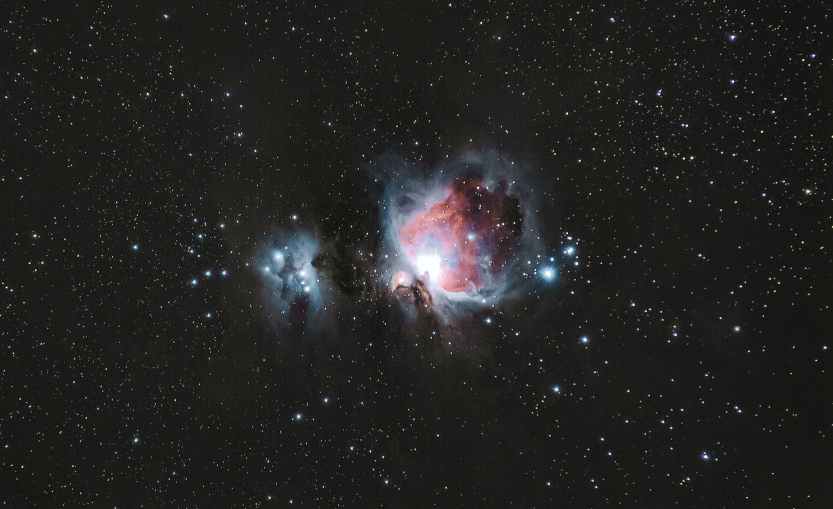
Hey there! I hope you are having a nice and beautiful day. I thought a lot about the topic from which I should start ASTROCOSMOS, and after a week-long, I figured the topic out. The topic I chose is big and I don’t want to rush through the details, so I’ve decided to break it into parts. There will be two parts of “US IN UNIVERSE” and to understand part 2, it is recommended to read this part first. Let’s start our journey by knowing our position in this vast, beautiful and terrifying universe!
On a very fine summer morning when you open curtains of your window to let some sunshine fall in your room, you must have seen a glowing speck of dust that is caught between the beam of light. Now, imagine that every glowing speck of dust is a GALAXY. Then, your whole room will represent the size of an observable UNIVERSE.
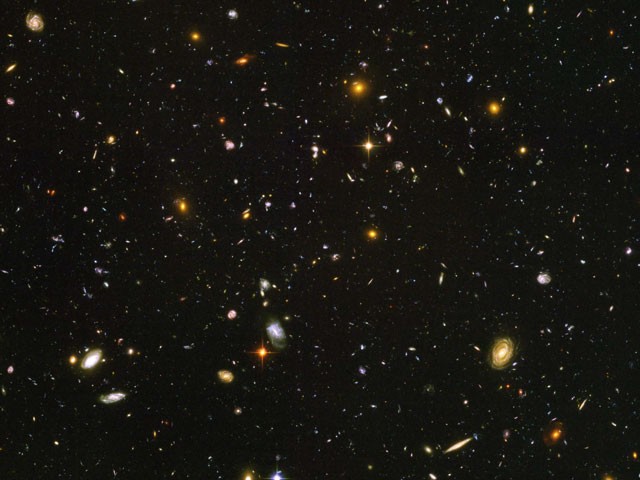
In simple words, A GALAXY is a collection of dust, gas and millions and billions of stars. It contains the family of the stars, their solar systems. All these things are held together by gravity, which according to Newton, is a force. As the flavours of ice cream, there are many different flavours — I mean shapes — of galaxies such as spiral, elliptical and some of them have very unusual shapes like toothpick or rings (source: NASA). An OBSERVABLE UNIVERSE is a spherical region of the universe, which contains all the matter that can be or is observed from the EARTH. It is about 46.508 billion light-years across and beyond it lies a universe from which the light has not reached us, till yet. And our universe is about 13.799 billion years old. We are living in a freaking universe that is 13.799 BILLION years old!!
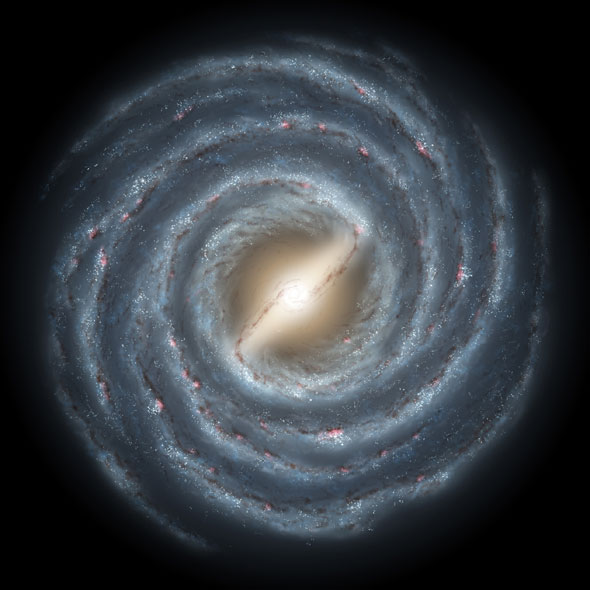
Now, somewhere between all those specks of dust lies our beautiful, spiral in shape, MILKY WAY GALAXY. Our colourful galaxy is a home for more than 200 billion stars, and is 13.51 BILLION years old and is 52,850 light-years across.
Some of you might have wonder “What the hell does this term ‘light year’ means?“. Well, our cosmos is so huge and vast that using normal units of distance, such as meters, inches or even miles, would be an insult to it. So scientists introduced a new term called LIGHT YEAR, which is a distance that light travels in one year (for some of the curious minds, light travels at a speed of 3*10^8 m/s ). Let’s take an example, Sunlight takes 8 minutes to reach us. So Sun is 8 light-minute away from us. Similarly, The Andromeda galaxy, the nearest galaxy to our milky way is about 2.3 million light-years away i.e, light takes 2.3 million years to reach the milky way, to us from the andromeda galaxy.
In the halo of our milky way galaxy lie a cluster of some tightly packed million stars, known as GLOBULAR CLUSTER. The word globular itself is derived from the Latin phrase which means a small sphere. These Globular clusters consist of some of the oldest stars of our galaxy and contain no sign of the young stars! There are about 150 of these clusters in our galaxy!! Yet, some of us have never heard of them.
Hope you enjoyed part 1 of “US IN UNIVERSE”. If you have any doubts or suggestions, please drop them in the comment section. Stay tuned to know about your position!!
CLICK HERE TO READ Us IN UNIVERSE – II
Don’t stop being curious and have a wonderful and warm week ahead!
Thank you!!
 ASTROCOSMOS
Well explained, and i got to know much bout space🔥
LikeLiked by 1 person
Thank you!! Please do subscribe to read more. Stay curious. 🙂
LikeLike
Best thing is that this blog which is about universe (most complicated thing) is explained in a very clear and easy way.
Points to be noted :-
*Easy Language.
*Facts are there.
*Gently presented blog.
LikeLiked by 2 people
Amazing
LikeLiked by 1 person
It’s so well explained.. I guess all other who read this will also get a chance, like I got, to know so much about the universe which we don’t usually get from other sources … Well done .. and thanks for such information and letting us know about our universe.. keep it up…
LikeLiked by 1 person
Engaging your readers throughout the writing is an art. It was nicely done by you. Well done 💯.
Hope to see the next part soon.
LikeLiked by 2 people
It is wonderful to discover the mysteries of the universe, also having an idea about how small we are in comparison. It is humiliating and yet, mesmerizing.
LikeLiked by 2 people
The universe is so vast, yet its marvels never fail to amaze us.
Stay curious! 🙂
LikeLike
Well Explained!!
LikeLiked by 1 person
Thank you!!
Please do subscribe to read more.
Stay curious. 🙂
LikeLike
Well explained……..
Keep it upp👍👍
LikeLiked by 1 person
Thank you!!
Please do subscribe to read more.
Stay curious. 🙂
LikeLike
Nyc 👍 keep it up✨✨
LikeLiked by 1 person
Thank you!!
Please do subscribe to read more. Stay curious. 🙂
LikeLike
The language used is quite simple to understand nand very interesting love to read more in the future ..
LikeLiked by 1 person
Thank you!! It is great to know you found the blog interesting.
Please do subscribe to read more. Stay curious. 🙂
LikeLike
I usually don’t like reading about universe because it makes me more confused. But your blog explained all the thing about this wide topic in such a simpler way that now I can’t wait for next part . Amazing one 👍
LikeLiked by 3 people
It feels so good to know that you liked the blog. Part 2 will be dropped shortly. Thank you so much Ishita!!
Stay curious. 🙂
LikeLike
Great…well done….proud of you !
LikeLiked by 1 person
Thank you, sir!!
Please do subscribe to read more. Stay curious. 🙂
LikeLike
Good take on this topic and well explained. Waiting for the 2nd part. If it possible then try to add the topic of ‘theory of parallel spaces’ which is also related to the same. Good luck
LikeLiked by 1 person
Thank you!! Part 2 will be dropped shortly. I’ll try to dig deep into the topic of ‘the theory of parallel space’ and present it as a blog.
Please do subscribe to read more. Stay curious. 🙂
LikeLike
Great!! Keep it up 🙂
LikeLiked by 1 person
Thank you!!
Please do subscribe to read more. Stay curious. 🙂
LikeLike
Complicated topic explained in very simple words.
Well done !!
LikeLiked by 1 person
Thank you!!
Please do subscribe to read more. Stay curious. 🙂
LikeLike
I m just so surprised to see this new way of learning..amazing step initiated by u kaman Dhiman…so impressed to see this….very well explained in such a creative manner…a grt experience…keep doing the good work👍👍👍
LikeLiked by 1 person
GREAT!! KEEP IT UP
LikeLiked by 1 person
Thank you!! Please do subscribe to read more. Stay curious. 🙂
LikeLike
Weldon
LikeLike
Enlightened me in many way. Very interesting!
LikeLiked by 1 person
Great blog! Happened to just randomly discover it. It’s well written and quite engaging. Everything about space and time is so so interesting. Good job!
LikeLiked by 1 person