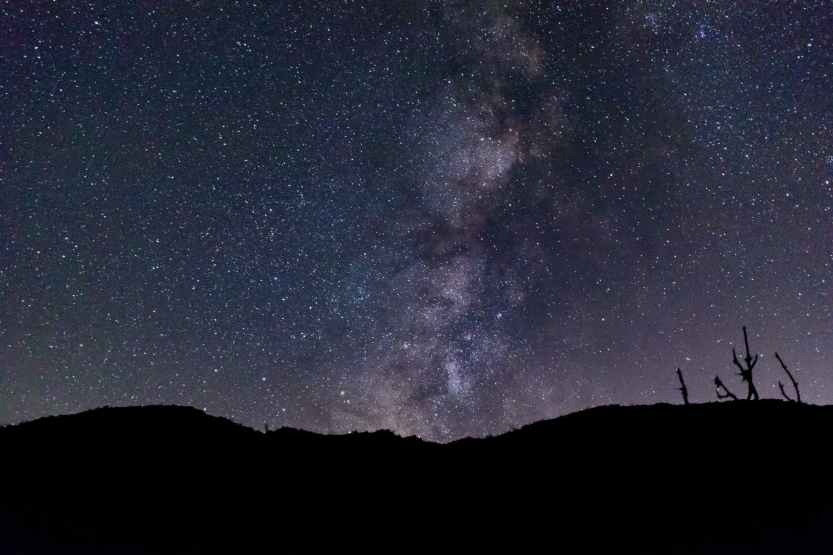
All we ever see of stars are their old photographs.
Alan Moore
I asked my little sister, “what comes to your mind when you think about stars?” and she starts reciting the poem written by Jane Taylor
“Twinkle, twinkle, little star,
How I wonder what you are!
Up above the world so high,
Like a diamond in the sky.”
From a very little age, we start wondering about the things around us, how they are formed, how they exist, and why they exist at all. And the night sky seems like the biggest riddle to us. Those small points, twinkled in the black sky, making everything a little more pleasant. And then we find ourselves asking how are these small points are formed?
So, I welcome you all to this journey where together, we will find out about how these balls of fire are formed. Let’s begin!
Those points that make us wonder are the cosmic factory, where all the elements are born. A factory that makes the universe a place sustainable for life. Those points are the stars, just like our Sun but very far away.
The story of the formation of stars, the stellar evolution started after 150 million years of the big bang when the fundamental physical properties of the universe conspired to pull together a set of atoms that previously had been occupying a volume a billion trillion times larger. The early universe was uniform and boring, but not so perfect. Some of the imperfections were the places where the density of matter was a little higher than the surrounding average. The cosmic wave background image, which shows the temperature of the universe at the time of the big bang, also shows the high-density and the low-density regions. More the temperature, the more the mass, and the more the density.

Slowly after the formation of the first elements: hydrogen and helium. They start to collect into the regions of high density with the help of gravity and dark matter, forming dark and gloomy gas clouds. These dark and gloomy interstellar clouds are at least light-years across and are often much larger. These clouds are called the Nebulas.
(In general, NEBULAS are the key to everything that came to be. They are interstellar clouds of dust, Hydrogen, and other ionized gases. For example, the Orion Nebula in the Orion constellation. There are two types of Nebulas: Stellar nebula and planetary nebula. The stellar nebula is where stars are born, whereas a planetary nebula is what some stars form at the end of their lives.)

The gas in the nebulas exerts pressure, an outward force. And according to the theory of relativity, the mass warps the space-time fabric around itself, creating the effect of gravity. So, the matter inside the gas clouds exerts an inward force also, gravity towards the center of the cloud. The condition called Hydrostatic equilibrium took place when the outward force remains precisely in balance with the inward.
That is when,
The kinetic energy of the gas pressure = gravitational potential energy
So how do the equilibrium breaks and formation of stars take place?
When the interstellar cloud is massive enough to overcome the threshold, gravity wins the contest. This threshold is called the Jeans mass. Or when the gas cloud experience some disturbance, and the “self-pull” becomes enough to overcome the underlying kinetic energy, the gravitational collapse happens.
As the gravitational collapse happens, gravity starts pulling the matter toward the center of the cloud. The centrifugal force comes into action, leading to the flat disk’s formation.
The collapsing of matter continues for millions of years until the gas reionizes into the plasma. As the interstellar cloud contracts, the atoms of gas collide with each other more and more frequently and at greater and greater speeds, due to which the gas heats up. A point is reached where no neutral atom exists. Eventually, the inner region of the gas becomes so hot and the gravitational potential energy converts into thermal energy. That sets in the motion a competition between the gravity working to condense the matter and the thermal energy pressure spreading matter apart. This is called the Protostar, an object that is in temporary hydrostatic equilibrium. And this phase is called the protostellar phase, which is the earliest in stellar evolution. For a low-mass star (i.e. that of the Sun or lower), it lasts about 500,000 years. The creation of Protostars can be seen through infrared vision as the Protostars are warmer than other materials in the molecular cloud.

The growing mass at the center creates a gravitational pull, drawing ever more gas and dust inwards, gravitational potential energy. A bit like water going down a plughole, the material being pulled in starts to spin round. The powerful winds develop and the jets of gas blows out from the center of the disk.
Now, The core of the protostar becomes so hot and dense that nuclear fusion starts taking place, along with the tremendous energy that fusion generates. The Hydrogen atoms no longer bounce off each other but instead coalesce to form Helium. The heat released in this nuclear fusion is what makes the star shines. This additional heat also increases the pressure of the gas until it is sufficient to balance the gravitational attraction, and then the gas stops contracting. It is now a “main sequence star.” The star is formed and is shining at a young age. The newly formed stars are huge spinning globes of hot, glowing gas.
Now, what are the stars? What are the points that you see twinkling in the night?
The STARS are like extensive nuclear power plants that convert Hydrogen to Helium and are responsible for forming all kinds of elements in their core. The element from which we are made is manufactured in the core of stars. We’re stardust. Each one of us is a child of the cosmos!

The stars are the dreams that every one of us had dreamt of as a child. Stars are more than physics, we are attached to them on an emotional level. We’re little stars living on the planet Earth!
Here’s the famous story of making the apple pie from the scratch:
“To make an apple pie, you need wheat, apples, a pinch of this and that, and the heat of the oven. The ingredients are made of molecules- sugar, say, or water. The molecules, in turn, are made of atoms- carbon, oxygen, hydrogen, and a few others. Where do these atoms come from? Except for hydrogen, they are all made in the stars. A star is a kind of cosmic kitchen inside which atoms of hydrogen are cooked into heavier atoms. Stars condense from interstellar gas and dust, which are mostly composed of hydrogen. But the hydrogen was made in the big bang, the explosion that began the cosmos. If you wish to make an apple pie from scratch, you must first invent the universe.”
Carl Sagan
 ASTROCOSMOS